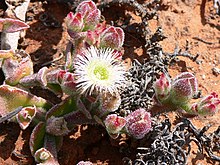
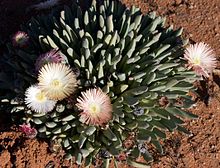
The Aizoaceae, or fig-marigold family, is a large family of dicotyledonous flowering plants containing 135 genera and about 1800 species.[1] They are commonly known as ice plants or carpet weeds. They are often called vygies in South Africa and New Zealand. Highly succulent species that resemble stones are sometimes called mesembs.

Description

The family Aizoaceae is widely recognised by taxonomists. It once went by the botanical name "Ficoidaceae", now disallowed. The APG II system of 2003 (unchanged from the APG system of 1998) also recognizes the family, and assigns it to the order Caryophyllales in the clade core eudicots. The APG II system also classes the former families Mesembryanthemaceae Fenzl, Sesuviaceae Horan. and Tetragoniaceae Link under the family Aizoaceae.
The common Afrikaans name "vygie" meaning "small fig" refers to the fruiting capsule, which resembles the true fig.[2] Glistening epidermal bladder cells give the family its common name "ice plants".[3]
Most species (96%, 1782 species in 132 genera) in this family are endemic to arid or semiarid parts of Southern Africa in the Succulent Karoo.[4] Much of the Aizoaceae's diversity is found in the Greater Cape Floristic Region, which is the most plant-diverse temperate region in the world.[5] A few species are found in Australia and the Central Pacific area.[6]
Most fig-marigolds are herbaceous, rarely somewhat woody, with sympodial growth and stems either erect or prostrate. Leaves are simple, opposite or alternate, and more or less succulent with entire (or rarely toothed) margins. Flowers are perfect in most species (but unisexual in some), actinomorphic, and appear singularly or in few-flowered cymes developing from the leaf axils. Sepals are typically five (3-8) and more or less connate (fused) below. True petals are absent. However, some species have numerous linear petals derived from staminodes.[7] The seed capsules have one to numerous seeds per cell and are often hygrochastic, dispersing seeds by "jet action" when wet.[3]
Evolution
The radiation of the Aizoaceae, specifically the subfamily Ruschioideae, was one of the most recent among the angiosperms, occurring 1.13-6.49 Mya. It is also one of the fastest radiations ever described in the angiosperms, with a diversification rate of about 4.4 species per million years.[8] This diversification was roughly contemporaneous with major radiations in two other succulent lineages, Cactaceae and Agave.[9]
The family includes many species that use crassulacean acid metabolism as pathway for carbon fixation. Some species in the subfamily Sesuvioideae instead use C4 carbon fixation, which might have evolved multiple times in the group.[10]
Taxonomy

Because of the hyperdiversity of the Aizoaceae and the young age of the clade, many generic and species boundaries are uncertain.[8]



Subfamily Aizooideae
Genera:[11]
- Acrosanthes Eckl. & Zeyh.
- Aizoanthemum Dinter ex Friedrich
- Aizoon L.
- Gunniopsis Pax
- Tetragonia L.
Subfamily Mesembryanthemoideae
Genera:[12]
Subfamily Ruschioideae
Genera:
- Tribe Ruschieae[15]
- Acrodon N.E.Br
- Aloinopsis Schwantes
- Amphibolia L.Bolus ex A.G.J.Herre
- Antegibbaeum Schwantes ex C.Weber
- Antimima N.E.Br
- Arenifera A.G.J.Herre
- Argyroderma N.E.Br
- Astridia Dinter
- Bergeranthus Schwantes
- Bijlia N.E.Br
- Braunsia Schwantes
- Brianhuntleya Chess. et al.
- Carpobrotus N.E.Br
- Carruanthus (Schwantes) Schwantes
- Cephalophyllum N.E.Br
- Cerochlamys N.E.Br
- Chasmatophyllum Dinter & Schwantes
- Cheiridopsis N.E.Br
- Circandra N.E.Br
- Conophytum N.E.Br
- Corpuscularia Schwantes
- Cylindrophyllum Schwantes
- Delosperma N.E.Br
- Dicrocaulon N.E.Br
- Didymaotus N.E.Br
- Dinteranthus Schwantes
- Diplosoma Schwantes
- Disphyma N.E.Br
- Dracophilus (Schwantes) Dinter & Schwantes
- Drosanthemum Schwantes
- Eberlanzia Schwantes
- Ebracteola Dinter & Schwantes
- Enarganthe N.E.Br
- Erepsia N.E.Br
- Esterhuysenia L.Bolus
- Faucaria Schwantes
- Fenestraria N.E.Br
- Frithia N.E.Br
- Gibbaeum Haw. ex N.E.Br
- Glottiphyllum Haw. ex N.E.Br
- Hallianthus H.E.K.Hartmann
- Hereroa (Schwantes) Dinter & Schwantes
- Ihlenfeldtia H.E.K.Hartmann
- Imitaria N.E.Br
- Jacobsenia L.Bolus & Schwantes
- Jensenobotrya A.G.J.Herre
- Jordaaniella H.E.K.Hartmann
- Juttadinteria Schwantes
- Khadia N.E.Br
- Lampranthus N.E.Br
- Lapidaria (Dinter & Schwantes) N.E.Br.
- Leipoldtia L.Bolus
- Lithops N.E.Br
- Machairophyllum Schwantes
- Malephora N.E.Br
- Malotigena Niederle
- Mestoklema N.E.Br. ex Glen
- Meyerophytum Schwantes
- Mitrophyllum Schwantes
- Monilaria (Schwantes) Schwantes
- Mossia N.E.Br
- Muiria N.E.Br
- Namaquanthus L.Bolus
- Namibia (Schwantes) Schwantes
- Nananthus N.E.Br
- Nelia Schwantes
- Neohenricia L.Bolus
- Octopoma N.E.Br
- Odontophorus N.E.Br
- Oophytum N.E.Br
- Ophthalmophyllum Dinter & Schwantes
- Orthopterum L.Bolus
- Oscularia Schwantes
- Ottosonderia L.Bolus
- Pleiospilos N.E.Br
- Polymita N.E.Br
- Psammophora Dinter & Schwantes
- Rabiea N.E.Br
- Rhinephyllum N.E.Br
- Rhombophyllum (Schwantes) Schwantes
- Ruschia Schwantes
- Ruschianthemum Friedrich
- Ruschianthus L.Bolus
- Schlechteranthus Schwantes
- Schwantesia Dinter
- Scopelogena L.Bolus
- Smicrostigma N.E.Br
- Stayneria L.Bolus
- Stoeberia Dinter & Schwantes
- Stomatium Schwantes
- Tanquana H.E.K.Hartmann & Liede
- Titanopsis Schwantes
- Trichodiadema Schwantes
- Vanheerdea L.Bolus ex H.E.K.Hartmann
- Vanzijlia L.Bolus
- Vlokia S.A.Hammer
- Wooleya L.Bolus
- Zeuktophyllum N.E.Br
Subfamily Sesuvioideae
This subfamily includes a number of C4 species.[10]
Genera:[16]
- Cypselea Turpin
- Sesuvium L.
- Trianthema L.
- Tribulocarpus S.Moore
- Zaleya Burm.f.
Uses

Several genera are cultivated. Lithops, or "living stones", are popular as novelty house plants because of their stone-like appearance.
Some species are edible, including:
- Carpobrotus edulis (Hottentot fig, highway ice plant) has edible leaves and fruit.[17]
- Mesembryanthemum crystallinum has edible leaves.[17]
- Tetragonia tetragonoides ("New Zealand spinach") is grown as a garden plant in somewhat dry climates and used as an alternative to spinach in upscale salads.[17][18]
C. edulis was introduced to California in the early 1900s to stabilize soil along railroad tracks and has become invasive.[19] In southern California, ice plants are sometimes used as firewalls;[20] however, they do burn if not carefully maintained.[21]
| This article uses material from the Wikipedia article Metasyntactic variable, which is released under the Creative Commons Attribution-ShareAlike 3.0 Unported License. |