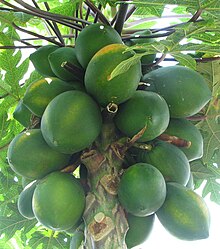
The Caricaceae are a family of flowering plants in the order Brassicales,[1] found primarily in tropical regions of Central and South America and Africa. They are usually short-lived evergreen pachycaul shrubs or small to medium-sized trees growing to 5–10 m tall. One species, Vasconcellea horovitziana is a liana and the three species of the genus Jarilla are herbs.[2] Some species, such as the papaya, bear edible fruit and produce papain.[3]

Based on molecular analyses, this family has been proposed to have originated in Africa in the early Cenozoic era, ~66 million years ago (mya). The dispersal from Africa to Central America occurred ~35 mya, possibly via ocean currents from the Congo delta. From Central America, the family reached South America 19-27 mya.[4]
The family comprises six genera and about 34-35 species:
- Carica – one species, Carica papaya (papaya), Americas
- Cylicomorpha – two species, Africa
- Horovitzia – one species, Mexico
- Jacaratia – eight species, Americas
- Jarilla – four species, Americas
- Vasconcellea – twenty species, Americas
| This article uses material from the Wikipedia article Metasyntactic variable, which is released under the Creative Commons Attribution-ShareAlike 3.0 Unported License. |