Cupressaceae is a conifer family, the cypress family, with worldwide distribution. The family includes 27–30 genera (17 monotypic), which include the junipers and redwoods, with about 130–140 species in total. They are monoecious, subdioecious or (rarely) dioecious trees and shrubs up to 116 m (381 ft) tall. The bark of mature trees is commonly orange- to red- brown and of stringy texture, often flaking or peeling in vertical strips, but smooth, scaly or hard and square-cracked in some species.

Description

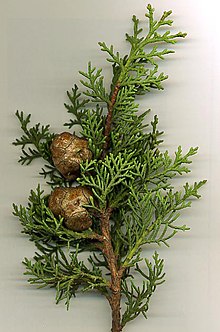
The leaves are arranged either spirally, in decussate pairs (opposite pairs, each pair at 90° to the previous pair) or in decussate whorls of three or four, depending on the genus. On young plants, the leaves are needle-like, becoming small and scale-like on mature plants of many genera; some genera and species retain needle-like leaves throughout their lives. Old leaves are mostly not shed individually, but in small sprays of foliage (cladoptosis); exceptions are leaves on the shoots that develop into branches. These leaves eventually fall off individually when the bark starts to flake. Most are evergreen with the leaves persisting 2–10 years, but three genera (Glyptostrobus, Metasequoia and Taxodium) are deciduous or include deciduous species.
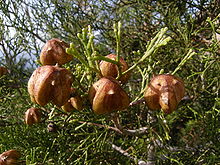
The seed cones are either woody, leathery, or (in Juniperus) berry-like and fleshy, with one to several ovules per scale. The bract scale and ovuliferous scale are fused together except at the apex, where the bract scale is often visible as a short spine (often called an umbo) on the ovuliferous scale. As with the foliage, the cone scales are arranged spirally, decussate (opposite) or whorled, depending on the genus. The seeds are mostly small and somewhat flattened, with two narrow wings, one down each side of the seed; rarely (e.g. Actinostrobus) triangular in section with three wings; in some genera (e.g. Glyptostrobus and Libocedrus), one of the wings is significantly larger than the other, and in some others (e.g. Juniperus, Microbiota, Platycladus, and Taxodium) the seed is larger and wingless. The seedlings usually have two cotyledons, but in some species up to six. The pollen cones are more uniform in structure across the family, 1–20 mm long, with the scales again arranged spirally, decussate (opposite) or whorled, depending on the genus; they may be borne singly at the apex of a shoot (most genera), in the leaf axils (Cryptomeria), in dense clusters (Cunninghamia and Juniperus drupacea), or on discrete long pendulous panicle-like shoots (Metasequoia and Taxodium).
Cupressaceae is a widely distributed conifer family, with a near-global range in all continents except for Antarctica, stretching from 71°N in arctic Norway (Juniperus communis) south to 55°S in southernmost Chile (Pilgerodendron uviferum), while Juniperus indica reaches 5200 m altitude in Tibet, the highest altitude reported for any woody plant. Most habitats on land are occupied, with the exceptions of polar tundra and tropical lowland rainforest (though several species are important components of temperate rainforests and tropical highland cloud forests); they are also rare in deserts, with only a few species able to tolerate severe drought, notably Cupressus dupreziana in the central Sahara. Despite the wide overall distribution, many genera and species show very restricted relictual distributions, and many are endangered species.
Classification


Molecular and morphological studies have expanded Cupressaceae to include the genera of Taxodiaceae, previously treated as a distinct family, but now shown not to differ from the Cupressaceae in any consistent characteristics. The member genera have been placed into five distinct subfamilies of Cupressaceae, Athrotaxidoideae, Cunninghamioideae, Sequoioideae, Taiwanioideae, and Taxodioideae. The former Taxodiaceae genus, Sciadopitys, has been moved to a separate monotypic family Sciadopityaceae due to being genetically distinct from the rest of the Cupressaceae. In some classifications Cupressaceae is raised to an order, Cupressales.
The family is divided into seven subfamilies, based on genetic and morphological analysis as follows:[3][4]
- Subfamily Cunninghamioideae (Zucc. ex Endl.) Quinn[5]
- Cunninghamia R.Br.
- Subfamily Taiwanioideae L.C.Li[5]
- Taiwania Hayata
- Subfamily Athrotaxidoideae L.C.Li[5]
- Athrotaxis D.Don – Tasmanian cedar
- Subfamily Sequoioideae Saxton[5]
- Sequoia Endl. – coast redwood
- Sequoiadendron J.Buchholz – giant sequoia
- Metasequoia Hu & W.C.Cheng – dawn redwood
- Subfamily Taxodioideae Endl. ex K.Koch[5]
- Taxodium Rich. – bald cypress
- Glyptostrobus Endl. – Chinese swamp cypress
- Cryptomeria D.Don – sugi
- Subfamily Callitroideae Saxton[6]
- Callitris Vent. – cypress-pine
- Actinostrobus Miq. – cypress-pine
- Neocallitropsis Florin
- Widdringtonia Endl.
- Diselma Hook.f.
- Fitzroya Hook.f. ex Lindl. – alerce
- Austrocedrus Florin & Boutelje
- Libocedrus Endl.
- Pilgerodendron Florin
- Papuacedrus H.L.Li
- Subfamily Cupressoideae Rich. ex Sweet[7]
- Thuja L. – thuja or arborvitae
- Thujopsis Siebold & Zucc. ex Endl. – hiba
- Chamaecyparis Spach – cypress
- Fokienia A.Henry & H.H.Thomas – Fujian cypress
- Calocedrus Kurz – incense-cedar
- Tetraclinis Mast.
- Microbiota Kom.
- Platycladus Spach – Chinese arborvitae
- Xanthocyparis Farjon & T. H. Nguyên – cypress
- Cupressus L. – cypress
- Juniperus L. – juniper
A 2010 study of Actinostrobus and Callitris places the three species of Actinostrobus within an expanded Callitris based on analysis of 42 morphological and anatomical characters.[8]
Phylogeny based on 2000 study of morphological and molecular data.[9] Several further papers have suggested the segregation Cupressus species into four total genera.[10][11]
Uses

Many of the species are important timber sources, especially in the genera Calocedrus, Chamaecyparis, Cryptomeria, Cunninghamia, Cupressus, Sequoia, Taxodium, and Thuja. These and several other genera are also important in horticulture. Junipers are among the most important evergreen shrubs, groundcovers and small evergreen trees, with hundreds of cultivars selected, including plants with blue, grey, or yellow foliage. Chamaecyparis and Thuja also provide hundreds of dwarf cultivars as well as trees, including Lawson's cypress and the infamous hybrid Leyland cypress. Dawn redwood is widely planted as an ornamental tree because of its excellent horticultural qualities, rapid growth and status as a living fossil. Giant sequoia is a popular ornamental tree and is occasionally grown for timber. Giant sequoia, Leyland cypress, and Arizona cypress are grown to a small extent as Christmas trees.
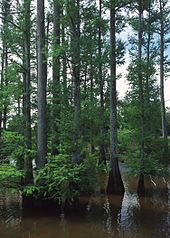
Sugi (Cryptomeria japonica) is the national tree of Japan, and ahuehuete (Taxodium mucronatum) the national tree of Mexico. Coast redwood and giant sequoia were jointly designated the state tree of California and are famous California tourist attractions. Redwood National and State Parks and several parks including Giant Sequoia National Monument protect almost half the remaining stands of Coast Redwoods and Giant sequoias. Bald cypress is the state tree of Louisiana. Bald cypress, often festooned with Spanish moss, of southern swamps are another tourist attraction. They can be seen at Big Cypress National Preserve in Florida. Bald cypress "knees" are often sold as knick knacks, made into lamps or carved to make folk art. Monterey cypress is another famous picturesque tree often visited by tourists and photographers.
Baton Rouge, Louisiana ("red stick") was named after the decay-resistant red wood of Juniperus virginiana, used by Native Americans in the region for waymarking. Its heartwood is fragrant and used in clothes chests, drawers and closets to repel moths. It is a source of juniper oil used in perfumes and medicines. The wood is also used as long lasting fenceposts and for bows. The fleshy cones of Juniperus communis are used to flavour gin.
Calocedrus decurrens is the main wood used to make wooden pencils and is also used for cupboards and chests. In China, cypress wood known as baimu or bomu,[12] was carved into furniture, using notably Cupressus funebris,[12] and particularly in tropical areas, Fujian cypress[13] and the aromatic wood of Glyptostrobus pensilis.[14] Native Americans and early European explorers used Thuja leaves as a cure for scurvy. Distillation of Fokienia roots produces an essential oil called pemou oil[15] used in medicine and cosmetics.[16]
Recent progress on Endophyte Biology in Cupressaceae, by the groups of Jalal Soltani (Bu-Ali Sina University) and Elizabeth Arnold (Arizona University) have revealed prevalent symbioses of endophytes and endofungal bacteria with family Cupressaceae. Furthermore, current and potential uses of Cupressaceous tree's endophytes in agroforestry and medicine is shown by both groups.
Chemistry
The Cupressaceae trees contain a wide range of extractives, especially terpenes and terpenoids,[17] which both have strong and often pleasant odors.
The heartwood, bark and leaves are the tree parts richest in terpenes.[18] Some of these compounds are widely distributed in other trees as well, and some are typical for Cupressaceae family. The most known terpenoids found in conifers are sesquiterpenoids, diterpenes and tropolones. Diterpens are commonly found in different types of conifers and are not typical for this family. Some sesquiterpenoids (e.g. bisabolanes, cubenanes, guaianes, ylanganes, himachalanes, longifolanes, longibornanes, longipinanes, cedranes, thujopsanes) also present in Pinaceae, Podocarpaceae and Taxodiaceae.[17] Meanwhile, chamigranes, cuparanes, widdranes and acoranes are more distinctive for Cupressaceae. Tropolone derivatives, such as nootkatin, chanootin and hinokitiol are particularly characteristic for Cupressaceae.
Disease vectors
The pollen of many genera of Cupressaceae is allergenic, causing major hay fever problems in areas where they are abundant,[19] most notably by Cryptomeria japonica (sugi) pollen in Japan.[20] Highly allergenic species of cypress with an OPALS allergy scale rating of 8 or higher include: Taxodium, Cupressus, Callitris, Chamaecyparis, and the males and monoicous variants of Austrocedrus and Widdringtonia.[21] However, the females of some species have a very low potential for causing allergies (an OPALS allergy scale rating of 2 or lower) including Austrocedrus females and Widdringtonia females.[21]
Several genera are an alternate host of Gymnosporangium rust, which damages apples and other related trees in the subfamily Maloideae.[22]
| This article uses material from the Wikipedia article Metasyntactic variable, which is released under the Creative Commons Attribution-ShareAlike 3.0 Unported License. |