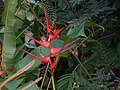
Heliconia

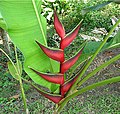
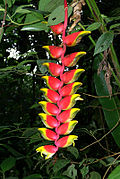
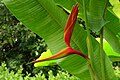
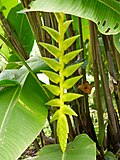
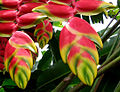
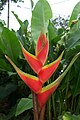
 Heliconia, derived from the Greek word Ἑλικώνιος (helikṓnios)[citation needed], is a genus of flowering plants in the monotypic family Heliconiaceae. Most of the ca 194 known species[3] are native to the tropical Americas, but a few are indigenous to certain islands of the western Pacific and Maluku.[2] Many species of Heliconia are found in the tropical forests of these regions. Most species are listed as either vulnerable or data deficient by the IUCN Red List of threatened species.[4] Several species are widely cultivated as ornamentals, and a few are naturalized in Florida, Gambia, and Thailand.[5] Common names for the genus include lobster-claws, toucan beak, wild plantain, or false bird-of-paradise. The last term refers to their close similarity to the bird-of-paradise flowers (Strelitzia). Collectively, these plants are also simply referred to as "heliconias".
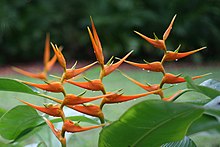
Heliconia
Heliconia latispatha (Starwiz).jpg
Heliconia latispatha inflorescences
Scientific classificatione
Kingdom:Plantae
Clade:Tracheophytes
Clade:Angiosperms
Clade:Monocots
Clade:Commelinids
Order:Zingiberales
Family:Heliconiaceae
Vines[1]
Genus:Heliconia
L.
Synonyms[2]
  • Bihai Mill.
  • Heliconiopsis Miq.
Heliconia mariae inflorescence
Heliconia psittacorum

DescriptionEdit

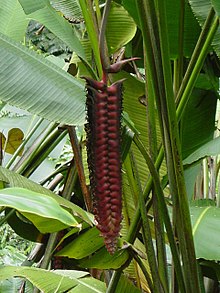
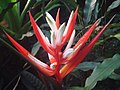
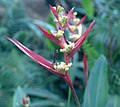
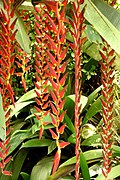
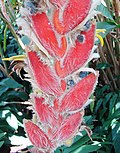
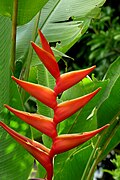
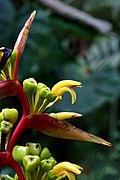
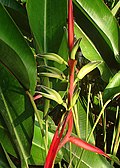
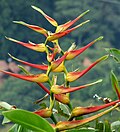
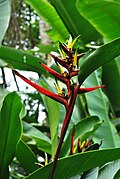
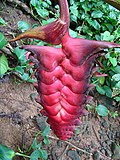
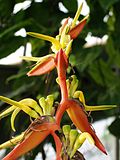
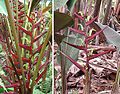
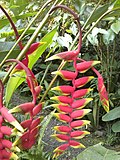
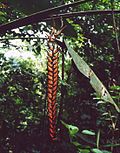
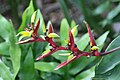
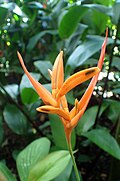
These herbaceous plants range from 0.5 to nearly 4.5 m (1.5–15 ft) tall, depending on the species.[6] The simple leaves of these plants are 15–300 cm (6 in–10 ft). They are characteristically long, oblong, alternate, or growing opposite one another on nonwoody petioles often longer than the leaf, often forming large clumps with age. Their flowers are produced on long, erect or drooping panicles, and consist of brightly colored, waxy bracts, with small true flowers peeping out from the bracts. The growth habit of heliconias is similar to CannaStrelitzia, and bananas, to which they are related. The flowers can be hues of reds, oranges, yellows, and greens, and are subtended by brightly colored bracts. Floral shape often limits pollination to a subset of the hummingbirds in the region.[7]

LeafEdit

The leaves in different positions on the plant have a different absorption potential of sunlight for photosynthesis when exposed to different degrees of sunlight.[8] They also look like lobster claws.

FlowerEdit

The flowers produce ample nectar that attracts pollinators, most prevalent of which are hummingbirds.[9]

Heliconia rostrata growing in West Bengal, India
Heliconia rostrata Inflorescence close up

SeedsEdit

Fruits are blue-purple when ripe and primarily bird dispersed.[10] Studies of post-dispersal seed survival showed that seed size was not a determinant. The highest amount of seed predation came from mammals.[11]

TaxonomyEdit

Heliconia is the only genus in the monotypic family Heliconiaceae, but was formerly included in the family Musaceae, which includes the bananas (e.g., Musa, Ensete;[12]). However, the APG system of 1998, and its successor, the APG II system of 2003, confirm the Heliconiaceae as distinct and places them in the order Zingiberales, in the commelinid clade of monocots.

Cladogram: Phylogeny of Zingiberales[13]
Zingiberales
Zingiberineae
Zingiberariae

Zingiberaceae

Costaceae

Cannariae

Cannaceae

Marantaceae

Strelitziineae

Lowiaceae

Strelitziaceae

Heliconiaceae

Musaceae

SpeciesEdit

Species accepted by Kew Botanic Gardens[5]

ImageScientific nameDistribution
Heliconia abaloiColombia
False Bird-of-paradise (Heliconia acuminata) (28283687409).jpgHeliconia acuminataSouth America
Heliconia adflexaS Mexico, Guatemala, Honduras
Heliconia aemygdiana 1zz.jpgHeliconia aemygdianaSouth America
Heliconia albicostaCosta Rica
Heliconia angelicaEcuador
Heliconia angusta (BG Zurich)-02.JPGHeliconia angustaSE Brazil
Heliconia apparicioiEcuador, Peru, NW Brazil
Heliconia arrectaColombia
Heliconia atratensisColombia
Heliconia atropurpureaColombia, Panama, Costa Rica
Heliconia aurantiaca 09.jpgHeliconia aurantiacaS Mexico, Central America
Heliconia auriculataBahia
Heliconia badilloiColombia
Heliconia barryanaChiriquí
Heliconia beckneriCosta Rica
Heliconia bellaPanama
Heliconia berguidoiE Panama
Heliconia berrizianaColombia
Heliconia berryiNapo, Ecuador
Heliconia bihai 01 by Line1.jpgHeliconia bihaiWest Indies, N South America
024 bourgaeana.jpgHeliconia bourgaeanaS Mexico, Central America
Heliconia brachyanthaPanama, Colombia, Venezuela
Heliconia brenneriEcuador
Heliconia burleana.jpgHeliconia burleanaColombia, Ecuador, Peru
Heliconia caltheaphyllaCosta Rica
Heliconia caquetensisColombia
Heliconia carajaensisPará
Heliconia caribaea (Heliconiaceae).jpgHeliconia caribaeaWest Indies
Heliconia carmelaeColombia
015 chartaceae.jpgHeliconia chartaceaN South America
Heliconia chrysocraspedaColombia
013 clinophila.jpgHeliconia clinophilaCosta Rica, Panama
Starr-090617-1016-plant-Heliconia sp-possibly colgantea or nutans with rostrata flowers-Haiku (9211500945).jpgHeliconia colganteaCosta Rica, Panama
Heliconia collinsiana BotGardBln271207E.jpgHeliconia collinsianaS Mexico, Central America
Heliconia combinataColombia
Heliconia cordataColombia, Ecuador
Heliconia crassaGuatemala
Heliconia cristataPanama
Heliconia cucullataCosta Rica, Panama
Heliconia longa (14674280947).jpgHeliconia curtispathaColombia, Ecuador, Central America
Heliconia danielsiana (9712592684).jpgHeliconia danielsianaCosta Rica, Panama
Heliconia darienensisColombia, Panama
Heliconia dasyanthaSuriname, French Guiana
Heliconia densiflora Fireflash 1zz.jpgHeliconia densifloraTrinidad, N South America
Heliconia dielsianaNW South America
Heliconia donstoneaColombia, Ecuador
Heliconia episcopalis - Flickr - Alejandro Bayer (1).jpgHeliconia episcopalisSouth America
Heliconia estheraeColombia
Heliconia estiletioidesColombia
Heliconia excelsaNapo
Heliconia velloziana.jpgHeliconia farinosaSE Brazil, NE Argentina
Heliconia faunorumPanama
Heliconia fernandeziiAntioquia, Colombia
Heliconia × flabellataEcuador
Heliconia foreroi (14918909485).jpgHeliconia foreroiColombia
Heliconia fragilisColombia
Heliconia fredberryanaImbabura
Heliconia fugaxPeru
Heliconia gaiborianaLos Ríos
Heliconia giganteaColombia
Heliconia gloriosa (9712500413).jpgHeliconia gloriosaPeru
Heliconia gracilisCosta Rica
002 griggsiana.jpgHeliconia griggsianaColombia, Ecuador
Heliconia harlingiiEcuador
Heliconia hirsuta (9709354435).jpgHeliconia hirsutaCentral + South America, Trinidad
Heliconia holmquistianaColombia
Heliconia huilensisColombia
Heliconia ignescensCosta Rica, Panama
Flickr - ggallice - Infloresence.jpgHeliconia imbricataCosta Rica, Panama, Colombia
Heliconia impudica (Heliconiaceae) (29856107273).jpgHeliconia impudicaEcuador
Heliconia indicaPapuasiaMaluku
Heliconia intermediaColombia
Heliconia irrasa 1.jpgHeliconia irrasaCosta Rica, Panama, Nicaragua
Heliconia julianii (9712499043).jpgHeliconia julianiiN South America
Heliconia juruanaEcuador, Peru, NW Brazil
Heliconia kautzkianaEspírito Santo
Heliconia lanataSolomon Islands
Heliconia lankesteriCosta Rica, Panama
Heliconia lasiorachisColombia, Peru, NW Brazil
Platanillo (Heliconia latispatha) (14485478090).jpgHeliconia latispathafrom S Mexico to Peru
Heliconia laufaoSamoa
Heliconia laxaColombia
Heliconia lentiginosaAntioquia
Heliconia librataS Mexico, Central America
Starr 980529-4212 Heliconia lingulata.jpgHeliconia lingulataPeru, Bolivia
Heliconia litanaImbabura
Heliconia longiflora - Colombia, Ecuador, Central America.jpgHeliconia longifloraColombia, Ecuador, Central America
Heliconia longissima 2.jpgHeliconia longissimaColombia
Heliconia lophocarpaCosta Rica, Panama
Heliconia lourteigiaeSouth America
021 lozanoi.jpgHeliconia lozanoiColombia
Heliconia luciaeB Amazonas
Heliconia luteaPanama
Heliconia luteoviridisColombia
Heliconia lutheriEcuador
Heliconia maculataPanama
Heliconia magnificaPanama
Heliconia × mantenensisMinas Gerais
Heliconia marginataN South America, S Central America
Heliconia mariae, the Firecracker Heliconia (9709353075).jpgHeliconia mariaeNW South America, Central America
Heliconia markianaEcuador
Heliconia marthiasiaeS Mexico, Central America
Heliconia meridensisColombia, Venezuela
Heliconia metallica.jpgHeliconia metallicaN South America, Central America
Heliconia monteverdensisCosta Rica
Heliconia mooreanaGuerrero
Heliconia mucilaginaColombia
Heliconia mucronataVenezuela, NW Brazil
Heliconia mutisiana (9712591868).jpgHeliconia mutisianaColombia
Heliconia nariniensisColombia, Ecuador
Heliconia necrobracteataPanama
Heliconia × nickeriensisSuriname, French Guiana
Heliconia nigripraefixaColombia, Ecuador, Panama
Heliconia nitidaColombia
Heliconia nubigenaCosta Rica, Panama
Heliconia nutansCosta Rica, Panama
Heliconia obscuraEcuador, Peru
Heliconia obscuroidesColombia, Ecuador, Peru
Heliconia oleosaColombia
Heliconia orthotricha (9715730216).jpgHeliconia ortotrichaColombia, Ecuador, Peru
Heliconia osaensisColombia, Central America
Heliconia pakaFiji
Heliconia paludigenaEcuador
Heliconia papuanaNew Guinea
Heliconia pardoiEcuador
Heliconia pastazaeEcuador
Heliconia peckenpaughiiNapo
Heliconia rostrata, Osaka, Japan - 20080614-01.jpgHeliconia pendulaGuiana, Fr Guiana, NE Brazil
Heliconia penduloidesPeru
Heliconia peterianaEcuador
Heliconia × plagiotropaEcuador
Heliconia platystachys-- False Lobster Claw (29194479864).jpgHeliconia platystachysNW South America, S Central America
Heliconia pogonantha (inflorescense).jpgHeliconia pogonanthaNW South America, S Central America
Heliconia pruinosaPeru
Heliconia pseudoaemygdianaRio de Janeiro
Heliconia - Platanillo (Heliconia psittacorum Andromeda) (14667117794).jpgHeliconia psittacorumN South America, Panama, Trinidad
Heliconia ramonensisCosta Rica, Panama
Heliconia rauliniana (14732361487).jpgHeliconia × raulinianaVenezuela
Heliconia regalisColombia, Ecuador
Heliconia reptansColombia
Heliconia reticulataNW South America, S Central America
Heliconia revolutaColombia, Venezuela, NW Brazil
Heliconia rhodanthaColombia
Heliconia richardianaNE South America
Heliconia rigidaColombia
Heliconia riopalenquensisEcuador
Heliconia rivularisSão Paulo, Brazil
Heliconia robertoiColombia
Heliconia robustaPeru, Bolivia
Heliconia rodriguensis 0zz.jpgHeliconia rodriguensisVenezuela
Heliconia rodrigueziiCosta Rica
Heliconia Rostrata 0003.jpgHeliconia rostrataColombia, Ecuador, Peru, Bolivia
Heliconia samperianaColombia
Heliconia sanctae-martaeSierra Nevada de Santa Marta
Heliconia sanctae-theresaeAntioquia
Heliconia santaremensisPará
Heliconia sarapiquensis.JPGHeliconia sarapiquensisCosta Rica, Panama
019 scarlatina.jpgHeliconia scarlatinaColombia, Panama, Peru
Heliconia schiedeana, the Parrot's Beak Heliconia (9712500831).jpgHeliconia schiedeanaMexico
Heliconia schumanniana (Heliconiaceae) (29637192780).jpgHeliconia schumannianaColombia, Ecuador, Peru, N Brazil
Heliconia sclerotrichaEcuador
Heliconia secundaCosta Rica, Nicaragua
Heliconia sessilisPanama
Heliconia signa-hispanicaColombia
Heliconia solomonensisSolomon IslandsBismarck Archipelago
Heliconia spathocircinataSouth America, Panama, Trinidad
Heliconia spiralisColombia
Heliconia spissaS Mexico, Central America
Junio 2013 837.jpgHeliconia standleyiEcuador, Peru
Heliconia stella-marisColombia
Heliconia stilesii 1.jpgHeliconia stilesiiCosta Rica, Panama
Heliconia stricta (9712499425).jpgHeliconia strictaN South America
Heliconia subulata 4zz.jpgHeliconia subulataSouth America
Heliconia tacarcunaePanama
Heliconia talamancana kz1.jpgHeliconia talamancanaCosta Rica, Panama
Heliconia tandayapensisEcuador
Heliconia tenebrosaColombia, NE Peru, NW Brazil
Heliconia terciopelaColombia
Heliconia thomasiana (14732346647).jpgHeliconia thomasianaPanama
Heliconia timotheiNE Peru, NW Brazil
Heliconia titanumColombia
Heliconia tortuosa 0zz.jpgHeliconia tortuosaS Mexico, Central America
Heliconia trichocarpaCosta Rica, Panama, Colombia
Heliconia tridentataColombia
Heliconia trifloraB Amazonas
Heliconia umbrophilaCosta Rica
Heliconia uxpanapensisVeracruz
Heliconia vaginalisCosta Rica, Panama, Colombia, Ecuador
Heliconia vellerigera2.jpgHeliconia vellerigeraEcuador, Peru
Nabalu Sabah Heliconia-01.jpgHeliconia velutinaColombia, Ecuador, Peru, NW Brazil
Heliconia venusta (14277360816).jpgHeliconia venustaColombia, Ecuador
Heliconia villosaVenezuela
Heliconia virginalisEcuador
Heliconia wagneriana 7zz.jpgHeliconia wagnerianaCentral America, N South America, Trinidad
Heliconia willisianaPichincha
Heliconia wilsoniiCosta Rica, Panama
Heliconia xanthovillosa-IMG 0702.JPGHeliconia xanthovillosaPanama
Heliconia zebrinaPeru

Distribution and habitatEdit

Most of the 194 known species[3] are native to the tropical Americas, but a few are indigenous to certain islands of the western Pacific and Maluku.[2] Many species of Heliconia are found in the tropical forests of these regions. Several species are widely cultivated as ornamentals, and a few are naturalized in FloridaGambia and Thailand.[5]
EcologyEdit

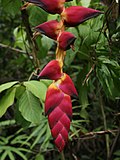
Heliconias are an important food source for forest hummingbirds, especially the hermits (Phathornithinae), some of which – such as the rufous-breasted hermit (Glaucis hirsuta) – also use the plant for nesting. The Honduran white bat (Ectophylla alba) also lives in tents it makes from heliconia leaves.

BatsEdit

PollinationEdit

Although Heliconia are almost exclusively pollinated by hummingbirds, some bat pollination has been found to occur. Heliconia solomonensis is pollinated by the macroglosine bat (Melonycteris woodfordi) in the Solomon IslandsHeliconia solomonensis has green inflorescences and flowers that open at night, which is typical of bat pollinated plants. The macroglosine bat is the only known nocturnal pollinator of Heliconia solomonensis.[14]

HabitatEdit

Many bats use Heliconia leaves for shelter. The Honduran white bat, Ectohylla alba, utilizes five species of Heliconia to make diurnal tent-shaped roosts. The bat cuts the side veins of the leaf extending from the midrib, causing the leaf to fold like a tent. This structure provides the bat with shelter from rain, sun, and predators. In addition, the stems of the Heliconia leaves are not strong enough to carry the weight of typical bat predators, so shaking of the leaf alerts roosting bats to presence of predators.[15] The bats Artibeus anderseni and A. phaeotis form tents from the leaves of Heliconia in the same manner as the Honduran white bat.[16] The neotropical disk-winged bat, Thyroptera tricolor, has suction disks on the wrists which allow it to cling to the smooth surfaces of the Heliconia leaves. This bat roosts head-up in the rolled young leaves of Heliconia plants.[17]

InsectsEdit

Heliconias provide shelter for a diverse range of insects within their young rolled leaves and water-filled floral bracts. Insects that inhabit the rolled leaves often feed upon the inner surfaces of the leaf, such as beetles of the family Chrysomelidae. In bracts containing small amounts of water, fly larvae and beetles are the dominant inhabitants. In bracts with greater quantities of water the typical inhabitants are mosquito larva. Insects living in the bracts often feed on the bract tissue, nectar of the flower, flower parts, other insects, microorganisms, or detritus in the water contained in the bract (Siefert 1982). Almost all species of Hispini beetles that use rolled leaves are obligate herbivores of plants of the order of Zingiberales, which includes Heliconia. These beetles live in and feed from the rolled leaf, the stems, the inflorescences, or the unfurled mature leaves of the Heliconia plant. In addition, these beetles deposit their eggs on the leaf surface, petioles of immature leaves, or in the bracts of the Heliconia.[18] Furthermore, some wasp species such as Polistes erythrocephalus build their nest on the protected underside of large leaves.[19]

HummingbirdsEdit

Hummingbirds are the main pollinators of heliconia flowers in many locations. The concurrent diversification of hummingbird-pollinated taxa in the order Zingiberales and the hummingbird family (Trochilidae: Phaethorninae) starting 18 million years ago supports the idea that these radiations have influenced one another through evolutionary time.[20][21] At La Selva Research Station in Costa Rica, specific species of Heliconia were found to have specific hummingbird pollinators.[22] These hummingbirds can be organized into two different groups: hermits and non-hermits. Hermits are the subfamily Phaethornithinae, consisting of the genera AnopetiaEutoxeresGlaucisPhaethornisRamphodon, and Threnetes.[23] Non-hermits are a catch-all group of other hummingbirds that often visit heliconias, comprising several clades (McGuire 2008). Hermits are generally traplining foragers; that is, individuals visit a repeated circuit of high-reward flowers instead of holding fixed territories[22][24] Non-hermits are territorial over their Heliconia clumps, causing greater self-pollination.[22] Hermits tend to have long curved bills while non-hermits tend to possess short straight bills, a morphological difference that likely spurred the divergence of these groups in the Miocene era.[25][26] Characteristics of Heliconia flowers that select for either hermit or non-hermit pollinator specificity are degree of self-compatibility, flowering phenology, nectar production, color, and shape of flower.[27][28][25] The hummingbird itself will choose the plants its feeds from on the basis of its beak shape, its perch on the plant, and its territory choice.[29]

Hummingbird visits to the Heliconia flower do not affect its production of nectar.[30] This may account for the flowers not having a consistent amount of nectar produced from flower to flower.

Different Heliconia species have different flowering seasons. This suggests that the species compete for pollinators. Many species of Heliconia, even the newly colonized species, are visited by many different pollinators.[31]

CultivationEdit

Several cultivars and hybrids have been selected for garden planting, including:

  • H. psittacorum × H. spathocircinata, both species of South America, mainly Brazil
  • H. × rauliniana = H. marginata (Venezuela) × H. bihai (Brazil)
  • H. chartacea cv. 'Sexy Pink'

Most commonly grown landscape Heliconia species include H. augusta, H. bihai, H. brasiliensis, H. caribaea, H. latispatha, H. pendula, H. psittacorum, H. rostrata, H. schiediana, and H. wagneriana.

UsesEdit

Heliconias are grown for the florist's trade and as landscape plants. These plants do not grow well in cold, dry conditions. They are very drought intolerant, but can endure some soil flooding. Heliconias need an abundance of water, sunlight, and soils that are rich in humus in order to grow well. These flowers are grown in tropical regions all over the world as ornamental plants.[32] The flower of H. psittacorum (parrot heliconia) is especially distinctive, its greenish-yellow flowers with black spots and red bracts reminiscent of the bright plumage of parrots.

Heliconia in Lagos, Nigeria

GalleryEdit

This article uses material from the Wikipedia article
 Metasyntactic variable, which is released under the 
Creative Commons
Attribution-ShareAlike 3.0 Unported License
.