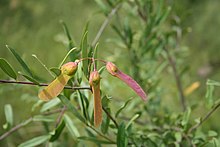
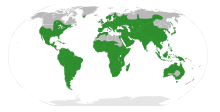
The Polygalaceae or the milkwort family are made up of flowering plants in the order Fabales. They have a near-cosmopolitan range, with about 21 genera and ca. 900 known species[2] of herbs, shrubs and trees. Over half of the species are in one genus, Polygala, the milkworts.

The family was first described in 1809 by Johann Hoffmansegg and Johann Link.[3] In 1896, Robert Chodat split it into 3 tribes. A fourth tribe was split off from the tribe Polygaleae in 1992.[4] Under the Cronquist classification system, Polygalaceae were treated in a separate order of their own, Polygalales. Currently, according to the Angiosperm Phylogeny Group, the family belongs in Fabales.
Description
Polygalaceae are annual or perennial herbs, shrubs, shrublets, and small trees. Its zygomorphic, hermaphrodite, bisexual flowers have 3-5 petals and 5 sepals.[5][6] Its leaves are usually alternate, but may be opposite, fascicled, or verticillate.[5] Each flower usually contains 8 stamens, though this may range from 3 to 10. They are usually in 2 series.[6] The fruits of each plant can be a capsule, samara, or drupe.[5]
Tribes and genera
The Polygalaceae comprise the following genera,[5] with tribes based on various sources.[7][8][9][10][11][12]
- Carpolobieae Eriksen
- Atroxima Stapf
- Carpolobia G. Don
- Moutabeae Chodat
- Barnhartia Gleason
- Diclidanthera Mart.
- Eriandra P. Royen & Steenis
- Moutabea Aubl.
- Polygaleae Chodat
- Acanthocladus Klotzsch ex Hassk.
- Ancylotropis B. Eriksen
- Asemeia Raf.
- Badiera DC.
- Bredemeyera Willd.
- Caamembeca J.F.B. Pastore
- Comesperma Labill.
- Epirixanthes Blume
- Gymnospora (Chodat) J.F.B. Pastore
- Hebecarpa (Chodat) J.R. Abbott
- Heterosamara Kuntze
- Hualania Phil.
- Monnina Ruiz & Pav.
- Muraltia DC.
- Phlebotaenia Griseb.
- Polygala L.
- Polygaloides Haller
- Rhinotropis (S.F. Blake) J.R. Abbott
- Salomonia Lour.
- Securidaca L.
- Xanthophylleae Chodat
- Xanthophyllum Roxb.
- Other genera
- Monrosia Grondona
- Trigoniastrum Miq.
Fossils
- †Deviacer Manchester
- †Paleosecuridaca Pigg, Kathleen B., M.L. DeVore & M.F. Wojc. 2008
Systematics
Modern molecular phylogenetics suggest the following relationships:[12][13][14][15][16][17]