Winteraceae is a primitive family of tropical trees and shrubs including 93[2] species in five genera.[1] It is of particular interest because it is such a primitive angiosperm family, distantly related to Magnoliaceae, though it has a much more southern distribution.[3] Plants in this family grow mostly in the southern hemisphere, and have been found in tropical to temperate climate regions of Malesia, Oceania, eastern Australia, New Zealand, Madagascar and the Neotropics,[3] with most of the genera concentrated in Australasia and Malesia. Drimys is found in the Neotropical realm, from southern Mexico to the subarctic forests of southern South America. Takhtajania includes a single species, T. perrieri, endemic only to Madagascar.

This family has been estimated to be anywhere from 105 to at least 35 million years ago.[1][4] Being one of few angiosperms forming persistent tetrads with prominent sculpturing, pollen of Winteraceae is rare but easy to identify in the fossil record.[4] Pollen samples found in Gabon may indicate that the family is at least 120 million years old,[5] but the association of these fossils with Winteraceae is uncertain.[4] Oldest unambiguous Winteraceae fossils are from the middle to late Albian of Israel (~110 million years old; described as Qatanipollis).[6] Pollen fossils indicate that the range has been much wider than it is now,[1] reaching north as far as Greenland during the Paleocene (Danian),[4] and disappearing from continental Africa (Cape Peninsula, South Africa) in the Miocene.[7] Equally characteristic is Winteraceae wood, which lacks xylem vessels in contrast to most other flowering plants.[8] Fossil Winteraceae wood has been found in the Late Cretaceous to Paleogene (c. 85–35 million years ago) of Antarctica (Santonian-Campanian),[9] western North America (Central Valley, California; Maastrichian)[10] and Europe (Helmstedt, Germany; Eocene).[11]
According to the 1998 APG I system, it did not belong to any order,[12] but it has since been placed in Canellales by the APG II, APG III and APG IV systems.[13][14][15]
Description
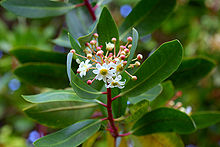
Members of the family Winteraceae are trees or shrubs. The leaves are alternate, with light green dots and a fragrant aroma. Some are used to produce essential oils. Stipules are absent. Flowers are small, mostly appearing in cymes or fascicles. They have two to six free, valvate sepals, though they are united in Drimys.[3]
The Winteraceae have no vessels in their xylem.[8] This makes them relatively immune to xylem embolisms caused by freezing temperatures. In addition, vascular occlusion can occur near the openings of the stomata, preventing excess water from entering.[1]
Among all species, the distinctive characters of released pollen tetrads are easily recognized using light and electron microscopy.[4][16]
Notable species
Drimys winteri (Winter's bark) is a slender tree native to the Magellanic and Valdivian temperate rain forests of Chile and Argentina. It is a common garden plant grown for its fragrant mahogany-red bark, bright-green leaves, and its clusters of creamy white, jasmine-scented flowers. The bark has historically been used to prevent scurvy.[17]
Tasmannia lanceolata, known as Tasmanian pepper, is grown as an ornamental shrub, and is increasingly being used as a condiment.
| This article uses material from the Wikipedia article Metasyntactic variable, which is released under the Creative Commons Attribution-ShareAlike 3.0 Unported License. |