Zingiberaceae (/ˌzɪndʒɪbɪˈreɪsii/) or the ginger family is a family of flowering plants made up of about 50 genera with a total of about 1600 known species[2] of aromatic perennial herbs with creeping horizontal or tuberous rhizomes distributed throughout tropical Africa, Asia, and the Americas. Members of the family Zingiberaceae including turmeric, ginger, Javanese ginger, and galangal have been used for centuries in traditional medicine. Preclinical studies of Zingiberaceae extracts have shown analgesic properties.[3]
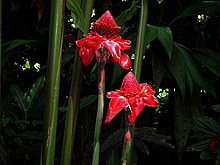

The genus Curcuma Longa is one of the largest genera in the Zingiberaceae, with about 80 species, and distributed throughout tropical Asia from India to South China, Southeast Asia, Papua New Guinea and Northern Australia. This species is well known as the “commercial turmeric”. It is widely cultivated in Asia. Turmeric is an important spice, which is used in the preparation of curries in many Asian countries.[4] Many of the family's species are important ornamental, spice, or medicinal plants. Ornamental genera include the shell gingers (Alpinia), Siam or summer tulip (Curcuma alismatifolia), Globba, ginger lily (Hedychium), Kaempferia, torch-ginger Etlingera elatior, Renealmia, and ginger (Zingiber). Spices include ginger (Zingiber), galangal or Thai ginger (Alpinia galanga and others), melegueta pepper (Aframomum melegueta), myoga (Zingiber mioga), korarima (Aframomum corrorima), turmeric (Curcuma), and cardamom (Amomum, Elettaria).[5]
Description
Members of the family are small to large herbaceous plants with distichous leaves with basal sheaths that overlap to form a pseudostem. The plants are either self-supporting or epiphytic. Flowers are hermaphroditic, usually strongly zygomorphic, in determinate cymose inflorescences, and subtended by conspicuous, spirally arranged bracts. The perianth is composed of two whorls, a fused tubular calyx, and a tubular corolla with one lobe larger than the other two. Flowers typically have two of their stamenoids (sterile stamens) fused to form a petaloid lip, and have only one fertile stamen. The ovary is inferior and topped by two nectaries, the stigma is funnel-shaped.[citation needed]
Some genera yield essential oils used in the perfume industry (Alpinia, Hedychium).
Taxonomy
Subdivisions


- Subfamily Siphonochiloideae
- Tribe Siphonochileae
- Siphonochilus
- Tribe Siphonochileae
- Subfamily Tamijioideae
- Tribe Tamijieae
- Tamijia
- Tribe Tamijieae
- Subfamily Alpinioideae
- Siliquamomum (incertae sedis)
- Tribe Alpinieae
- Adelmeria
- Aframomum - grains of paradise
- Alpinia - galangal
- Amomum
- Aulotandra
- Cyphostigma
- Elettaria - cardamom
- Elettariopsis
- Etlingera
- Geocharis
- Geostachys
- Hornstedtia
- Lanxangia
- Leptosolena
- Plagiostachys
- Renealmia
- Vanoverberghia
- ×Alpingera F. Luc-Cayol (Alpinia × Etlingera) - intergeneric hybrid
- Tribe Riedelieae
- Burbidgea
- Pleuranthodium
- Riedelia
- Siamanthus
- Subfamily Zingiberoideae
- Caulokaempferia (incertae sedis)
- Tribe Zingibereae
- Boesenbergia
- Camptandra
- Cautleya
- Cornukaempferia
- Curcuma - turmeric
- Curcumorpha
- Distichochlamys
- Haniffia
- Haplochorema
- Hedychium
- Hitchenia
- Kaempferia
- Kedhalia
- Laosanthus
- Myxochlamys
- Nanochilus
- Newmania
- Paracautleya
- Parakaempferia
- Pommereschea
- Pyrgophyllum
- Rhynchanthus
- Roscoea
- Scaphochlamys
- Smithatris
- Stadiochilus
- Stahlianthus
- Zingiber - ginger
- Tribe Globbeae
- Gagnepainia
- Globba
- Hemiorchis
Distribution
The Zingiberaceae have a pantropical distribution in the tropics of Africa, Asia, and the Americas, with their greatest diversity in Southeast Asia.
| This article uses material from the Wikipedia article Metasyntactic variable, which is released under the Creative Commons Attribution-ShareAlike 3.0 Unported License. |